Wildlife Conservation NetworkThe spirit of innovation in conservation
 
Cotton-top Tamarin Conservation
Rosamira Guillen

Rosamira Guillen, Photo: Frederico PardoRosamira Guillen, a native of Colombia, originally entered the field of wildlife protection as a landscape architect with the Barranquilla Zoo in northwest Colombia. She became Director of the zoo in 2001 and grew increasingly interested in developing partnerships with conservation organizations. She started an education campaign to highlight the plight of cotton-top tamarins, which led to a long-term collaboration with Proyecto Titi (PT). Rosamira is now PT's full-time Executive Director.

Threats

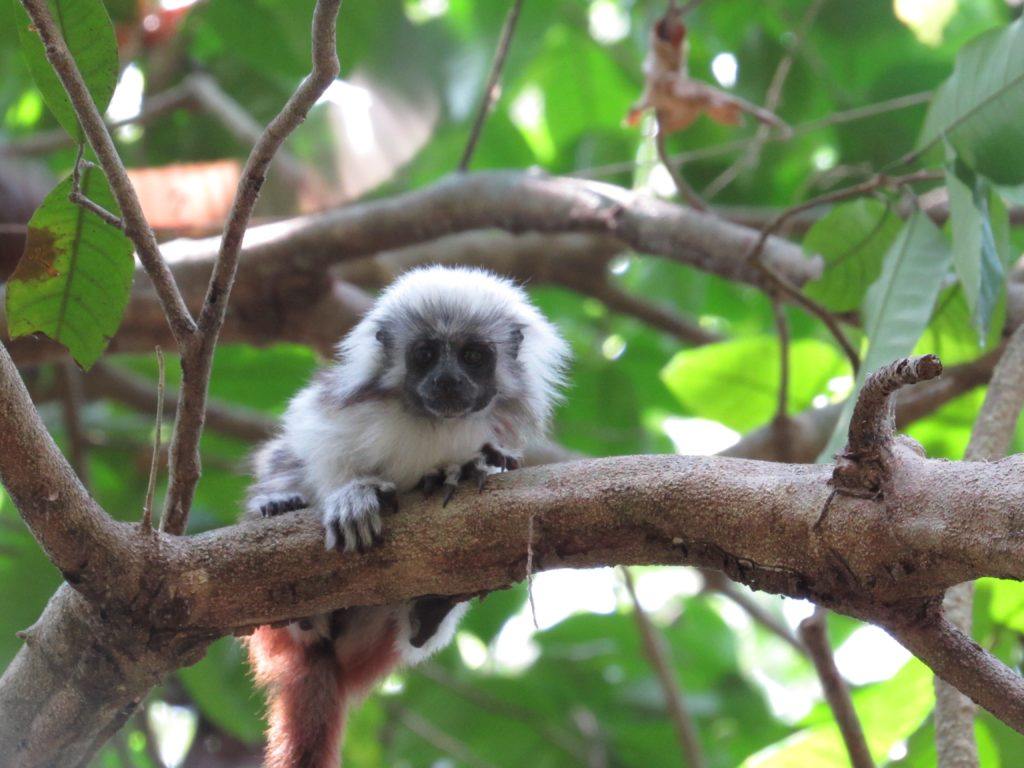
Cotton-top tamarin, Photo: Lisa HoffnerWeighing less than a pound, the cotton-top tamarin sports a shock of white hair on its head and a long tail that helps it balance in the treetops. Known as "South America's cutest monkey," the cotton-top tamarin is one of the most endangered primates in the world. The rapid destruction of its habitat by deforestation represents the greatest threat to the tamarin’s survival.

The cotton-top tamarin is endemic to Colombia and found only in the country’s northwest region.  It is estimated that only 6,000 individuals remain.  The species was declared endangered in 1973 following the exportation of 20,000 – 40,000 tamarins to the United States for use in biomedical research.  These close relatives of human beings were found to spontaneously develop colonic adenocarcinoma (a cancer of the colon). Tamarins served as the primary model for in-depth studies of colon cancer throughout the 1980's.

Forest destruction, Photo: Lisa HoffnerToday the primary threat to the survival of the cotton-top tamarin is destruction of its rainforest habitat for agriculture, fuel, and housing.  An astonishing 98% of its original habitat has been lost in the last seven years.  Only 7,600 acres of forest suitable for cotton-top tamarins remain.  The increase in cleared land has forced them to travel on the ground between forested sections, leaving them vulnerable to predation and capture.

The capture of individual monkeys for the pet trade also endangers the species.  Members of impoverished local communities hunt and trap tamarins as a source of income.  Many local residents are unaware of the endangered status of the cotton-top tamarin and the importance of protecting the biodiversity of its ecosystem.  Proyecto Titi is dedicated to increasing understanding and respect for the tamarin and fostering community involvement in conservation.

Solutions

Proyecto Tití (PT) combines field research with education initiatives and community programs. PT works closely with farmers to develop sustainable agricultural practices and improved land management techniques. Its programs focus on economic stability and present alternative income opportunities that decrease dependence on forest-product income. Hands-on educational programs foster a keen sense of pride and enthusiasm among local residents in protecting the unique biodiversity of their country.

Proyecto Tití was established in 1985 to develop a long-term conservation program to insure the survival of cotton-top tamarins.  Proyecto Tití is multi-disciplinary in nature:  Its researchers provide data on the reproductive biology, demography, behavior, feeding ecology, and infant development of cotton-top tamarins.  PT provides opportunities for urban and rural communities to engage in conservation education programs and to make a positive impact on their environment.  It develops alternative income activities which enable local communities to thrive economically without harming the cotton-top tamarin and its habitat.

Research

Cotton-top tamarins with dyed hair, Photo: Proyecto TitiData on cotton-top tamarin population trends and behaviors are crucial to developing strategies for the primate’s survival.  Given the small size of these monkeys, however, it is difficult to locate and follow known individuals in the wild.  Techniques developed by PT allow field researchers to identify individual animals and locate groups with ease.  Animals are captured twice a year, anesthetized, and marked with various bright colors using human hair dye.  The hair dye allows for identification through dense vegetation and withstands up to six months of exposure to intense rainy seasons.
      
Tamarins are monitored by radio telemetry.  The dominant male in each group is fitted with a radio transmitter in a backpack harness.  The transmitter weighs less than 3% of a tamarin’s body weight, and has a battery life of about nine months.  The backpack-style harness, attached with a shoelace, allows the male to carry the transmitter on the middle of its back such that it does not interfere with carrying infants.  The system also fits snugly on his body to minimize the possibility of becoming entangled in branches. 

Forest Protection

Forest destruction, Photo: Lisa HoffnerPT aims to counter the unprecedented destruction and fragmentation of the tropical forests in the northwest region of Colombia.  PT is working to purchase land that contains the last remaining contiguous forest suitable for cotton-top survival.  PT also works closely with local communities to protect and restore the fragile forests that remain.  Farmers set aside sections of their land to plant young trees that will provide food and protection for the cotton tops as well as fruit and other resources for the farmer.  These tracts of new forest also serve as important travel corridors for the tamarins.

Clay Bindes

Clay binde, Photo: Anne SavageA significant innovation in forest protection is the introduction of “clay bindes” in local communities, which reduce the amount of firewood required for cooking.  Open cooking fires are the cultural norm in villages, but demand for firewood is a significant stress on forest resources.  As an alternative, community members originally experimented with “bindes” – i.e. small stoves made from termite mounds.  The termite mounds are collected from the forest and reinforced by mud.  They have a hole on the side for firewood, small holes for air vents, and a hole on the top strong enough to support the weight of a small kettle. 

Bindes burn wood more efficiently than open fires and produce less smoke, but it is labor intensive to search the forest for termite mounds and prepare them for use.  PT introduced a new version of binde made out of clay.  These bindes can be fueled by refuse such as corn cobs, corn husks and coconut shells.  Clay bindes burn 2/3 less wood per day and make a significant impact in reducing deforestation.

Eco-Mochila Project

Collecting bags for eco-mochilas, Photo: Anne SavageThe eco-mochila project is a community-led enterprise that makes conservation of natural resources economically feasible and profitable. Local women transform discarded plastic bags into colorfully designed, hand-knit mochilas (tote bags). The trash bags are a ubiquitous form of waste that litter the countryside and pose a serious threat to the cotton-top and other animals that may ingest them. Children from the communities collect the bags (two million to date!), men clean and cut them into strips and the women crochet the bags into mochilas and other attractive accessories. The mochilas are sold throughout Colombia and internationally, thereby creating an alternative career and much-needed income.

In addition to earning a good income for their families and cleaning up the countryside, these enterprising women are also learning valuable skills. Together they formed their own small business, ASOARTESANAS, and learned how to save and invest. For those living a subsistence lifestyle, saving for the future was a foreign concept. Crochetting eco-mochilas, Photo: Lisa HoffnerTo date they have saved enough money to buy a plot of land and build a new workshop and community center. They purchased washing machines and refrigerators, and now provide food, education and medical care for their families. The women also started a day care center in the village.

With this stable source of income, residents are able to turn away from destructive economic activities, such as capturing cotton-top tamarins for the pet trade or contributing to deforestation by cutting down trees. Participants of the eco-mochila project commit to protecting the endangered primate and its forest habitat. Workshops provide participants with skills to become both artisans and conservation leaders. They acknowledge the impact of human pressures on natural resources and are finding ways to minimize them.

Conservation Education

Children's education program, Photo: Anne SavageConservation education is a primary focus for Proyecto Tití.  The team teaches schoolchildren and grown-ups alike about the forest and endemic animals, as well as the threats that they face.  The PT team was surprised to discover that 70% of local high school students had never visited the forest although it is only a few kilometers away from their villages.  PT collaborates with the Barranquilla Zoo to reach out to urban audiences as well.  Education programs in the city focus on the cotton-top tamarin in the pet trade, as urban residents are often the buyers of pets and create the demand. 

Collaborative programs involve exchange of information with schools in the United States.  Schoolchildren from both countries learn about and assess the state of their own natural resources and share results and ideas with each other.  Interactive experiences like this have helped to generate national pride in Colombia’s unique biodiversity and create a new ethic to secure a place for the cotton top tamarin in the future.


PROYECTO TITÍ’S NEW EDUCATOR

Proyecto Tití (PT) welcomes its newest member to the team - Johanna Vega, a 24-year old psychologist, born and raised in Barranquilla. Johanna joins PT as the Head of Education Programs, thus greatly expanding PT’s education and outreach capabilities. Johanna formerly worked at the Museum of the Caribbean Region in Barranquilla as an educator, where she worked in designing, implementing and evaluating education programs for visitors.

Johanna Vega, Proyecto Tití’s Head of Education Programs

There, Johanna had the opportunity to learn not only about the historical and cultural identity of the Colombian Caribbean region, but also about its vast natural richness and biodiversity, which generated a profound interest in this young professional: “I had no idea our region was so rich and diverse; it made me proud and it motivated me to learn more and to teach others”. Johanna had also been involved in many different volunteer programs while going to college, most of them related to developing leadership in young individuals.

Based on Johanna’s academic profile and professional experience, as well as her strong interest in environmental education, she was invited to join Proyecto Tití’s team to lead the implementation of our newly designed CARTITILLA program, an environmental education program which targets communities living in rural areas close to the forests cotton-top tamarins need to survive.

Johanna with the first group of Cartitilla students in the village of Santa Catalina

“This is a great opportunity for me. Creating environmental leaders that will make the right decisions in helping to protect cotton-top tamarins and the forests of north Colombia is my passion. I know we can make a difference”.

Johanna is currently developing a Masters Degree in Education. With her help we hope we can continue to engage people in understanding how they can help protect biodiversity for future generations of Colombians.

 
Support This Project
www.proyectotiti.com