The leadership of the Andean Cat Alliance reflects its character as a multinational coalition dedicated to the conservation of the feline throughout its four-country range. Rocio Palacios, a biologist from Argentina, serves as General Coordinator. The Assistant Coordinators are Lilián Villalba of Bolivia and Dr. Mauro Lucherini of Argentina. Each country has a Representative, and there is a Working Group Coordinator for each program area.
Rocio Palacios, General Coordinator, has studied the ecology, conservation status and distribution of the Andean cat in Argentina since 2003. Her involvement in wildlife protection began in her teens when she formed two conservation NGOs dedicated to improving the quality of life in human-dominated landscapes while preserving wild places. She is dedicated to building conservation capacity for the protection of Andean cats and other carnivores in the southern part of the cat’s distribution.
Lilián Villalba, Assistant Coordinator, is the former Director of the Museum of Natural History in La Paz, Bolivia. She holds Masters degrees in Wildlife Management and Integrative Biosciences. She has been engaged in Andean cat research since 1998 and is very involved in environmental education as a crucial element of Andean cat conservation. A researcher with the Colección Boliviana de Fauna, Lilián has been a member of the World Conservation Union/ Species Survival Commission Cat Specialist Group since 2002.
Dr. Mauro Lucherini, Assistant Coordinator, has led research and conservation campaigns in the northwestern High Andes of Argentina since 1998, organizing field surveys and conducting educational activities with local communities. Mauro is Joint Researcher of the Argentine National Commission for Scientific and Technological Research (CONICET). He is the Executive Coordinator of the Mammal Behavioral Ecology Group at Universidad Nacional de Sur in Argentina and a member of both the IUCN Cat and Canid Specialist Groups.
Working Group Coordinators & Governing Council:
Juan Reppucci - Investigation & Argentina Representative
Giovana Gallardo - Bolivia Representative
Agustín Iriarte - Conservation & Chile Representative
Anali Madrid - Education & Peru Representative
Jorgelina Marino - Distribution
The Andean cat is the most endangered cat species in the Americas. It lives exclusively in the high-altitude deserts of Argentina, Bolivia, Chile and Peru. Only slightly larger than a domestic cat, it is sometimes killed under the misconception of being dangerous. Some local people use stuffed cats and skins in traditional dances and religious ceremonies and believe that killing a cat will bring good fortune.
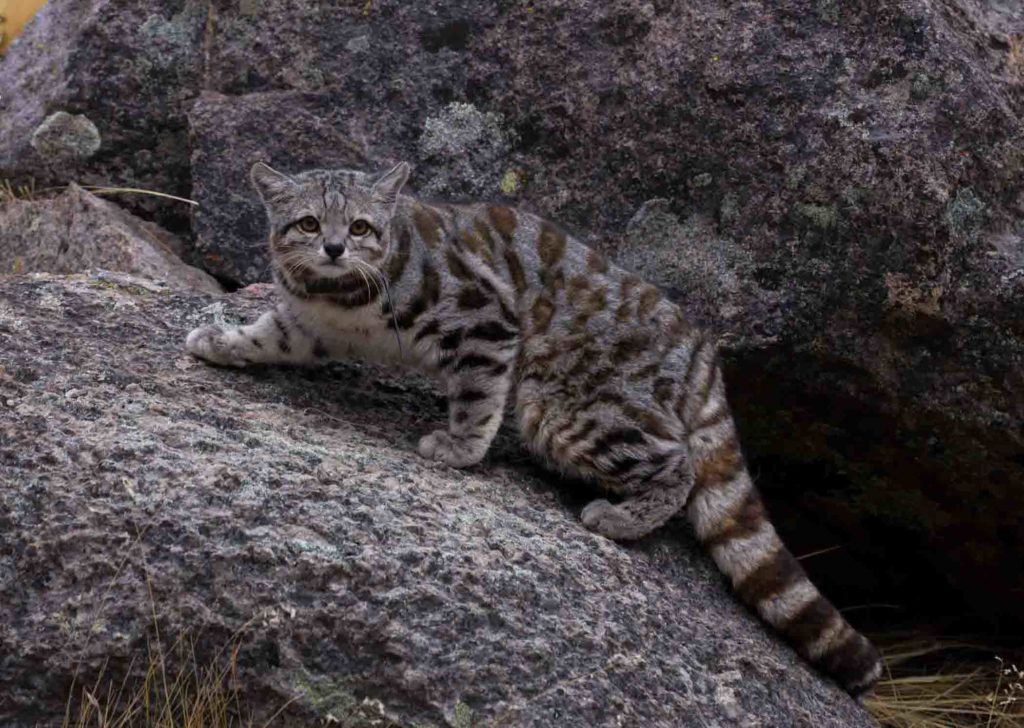
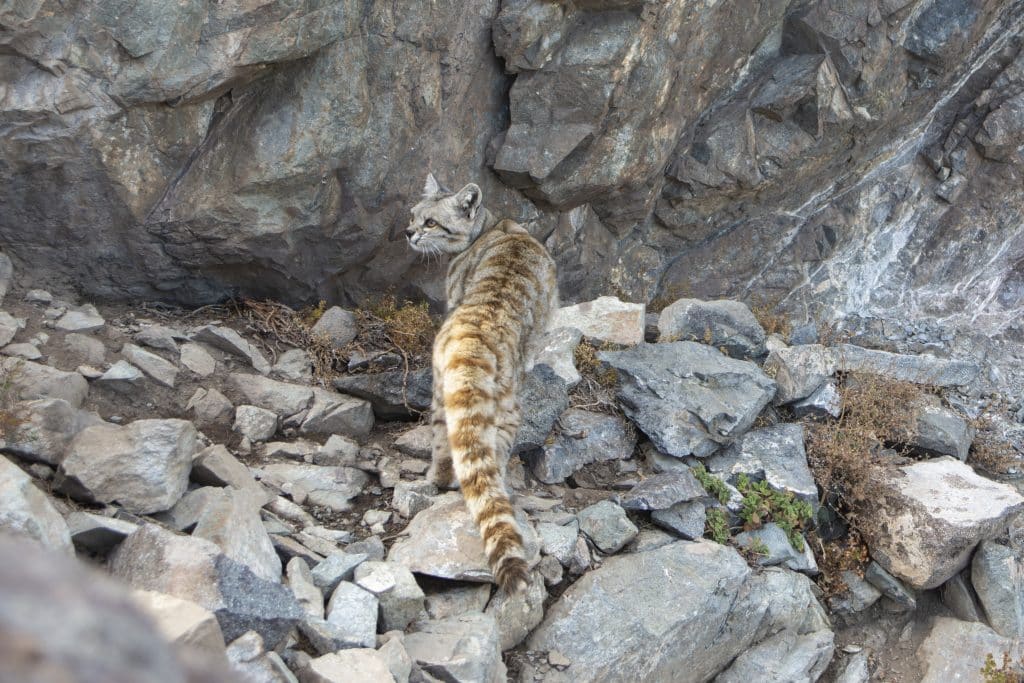
The Andean cat is small but sturdy with long ash-gray fur patterned with rusty red spots. Its thick, long tail is banded with approximately seven dark rings and makes it appear larger than it is. Living in rocky areas at high elevations, it is impressively adapted to the harsh climate of the Andes, which experiences frequent freezes, intense solar radiation, large daily thermal variations and low precipitation.
Because food in these severe conditions is scarce, the home ranges of the Andean cat are very large and their population densities low. Consequently, the Andean cat is also one of the most rare and least known felines in the world. In the last 25 years there have been fewer than 10 documented sightings, and there are no Andean cats in captivity.
The natural rarity of the Andean cat makes it particularly vulnerable to habitat loss. Fragmentation of its already isolated high rocky habitat due to livestock grazing, firewood extraction and mining can reduce population density to the point that even low levels of poaching may devastate the species. Lack of information on the species, absence of specific conservation policies and ineffective law enforcement pose challenges to the conservation of this elusive cat.
The Andean Cat Alliance, Alianza Gato Andino (AGA), works to protect the Andean cat in all four range countries. Conservationists from Argentina, Bolivia, Chile and Peru established the Alliance and produced a Conservation Action Plan in 2004. Collaboratively, they review current threats to the cat and coordinate conservation activities. Participation by local community members drives AGA's education and research programs.
AGA’s innovative and highly participative approach to conservation maximizes the efficiency of available resources and sets a stellar example for other multinational conservation initiatives. Its programs support local people in becoming conservation educators and researchers. The result is an increase in the knowledge necessary to refine effective conservation strategies, and a strengthened conservation ethic to support their implementation.
Unique Multinational Conservation Model
In keeping with the feline’s natural distribution, AGA employs a novel grassroots, yet cross-border approach to Andean cat conservation. Since high mountain ranges like the Andes often define international borders and therefore transect the Andean cat's habitat, it is imperative that a multinational and cooperative effort be undertaken to conserve the Andean cat throughout its full range. At the same time, AGA’s local researchers are in the best position to manage the conservation effort on the ground, since they are close to the issues and can influence government policy, local practices and education programs.
Success in the Field
AGA’s integrative approach has yielded groundbreaking field accomplishments, including:
- The first capture and radio-collaring of an Andean cat
- The first camera trap photographs of Andean cats in Argentina
- Use of camera trapping and DNA analysis of feces to confirm the Andean cat’s presence in three additional departments in Peru and one additional province in Argentina
- Completion of cat diet studies in Argentina and Chile, yielding important information on prey abundance and preferences
Research
AGA’s conservationists carry out research projects on the Andean cat to determine the geographic distribution and conservation status of this little known species. Research projects are focused on establishing the presence of the Andean cat and other carnivores in unexplored areas, evaluating the environmental and human variables that affect Andean cat distribution, and estimating its population densities and genetic variability. AGA members conduct field surveys based on interviews with local people and subsequently implement field campaigns. The results obtained thus far have contributed to the base of knowledge about the Andean cat that is critical to conservation efforts.
Local Wildlife Monitors
AGA researchers alone do not have the ample time and resources necessary to collect all potential data on the Andean cat and its whereabouts. Nor are they intimately familiar with the landscapes of all research sites. In order to gain the greatest knowledge of the Andean cat and set a foundation for continued research in the field, AGA conducts training programs for park guards and local people to fully engage them as wildlife monitors. By working with local stakeholders, AGA creates permanent field teams within the individual communities closest to Andean cat habitat. These field teams generate additional and key information on Andean cats and promote conservation as an important issue within their communities.
Conservation Education
Every Andean cat research project has an education component. AGA coordinates education activities in each of the four range countries. In November 2005, AGA conducted an international education workshop in Salta, Argentina to establish a global strategy for local community education, share experiences among participants and train country delegates in pedagogical techniques. One of the products of this workshop was the creation of a handbook, “Let Us Conserve the Andean Cat and its Habitat: Guide for Educators,” which details a full curriculum of activities for Andean cat conservation education.
AGA’s educational activities address general issues of environmental protection in the high Andean region, as well as the specific value of conserving the Andean cat. Activities include drawings, construction of a 3-D Andean cat model, mural paintings and games. AGA hosts community festivals to raise awareness of and celebrate conservation, as well as participatory workshops which provide the chance for all stakeholders to present their opinions on natural resources and the needs of the community. The workshops encourage participants to suggest possible alternatives to harmful practices and empower them to create conservation-friendly initiatives.
EcoMuseo
AGA is building an EcoMuseo (“Ecological Museum”) in the “Centro Poblado Menor de Alto Perú,” a Peruvian village located in a region where Andean cat presence has been confirmed. In close proximity to Bolivia and Chile, the village faces many of the same environmental issues as communities just across these borders. Economic difficulty is ubiquitous in this high Andean zone in which raising alpacas is virtually the sole source of income. Ecological degradation is also a reality as habitat loss results from the expansion of grazing lands in the effort to make a living.
The EcoMuseo will offer information on the fragility and importance of preserving the high Andean ecosystem and introduce sustainable practices for use of resources. The purpose of the EcoMuseo is to integrate environmental education with eco-tourism, an important alternative source of income. As a key component of the museum's overall conservation strategy to protect the Andean cat, the EcoMuseo is being designed to align with and celebrate the social, cultural and economic needs of the community.
Housed in an existing school structure, the EcoMuseo will be owned and managed by the community. The Parents Association will be in charge of its administration and utilize the profits to purchase books and supplies for the school. In cooperation with AGA, teachers and students will design the museum exhibits. The EcoMuseo has far-reaching potential not only to attract and offer information to visitors from neighboring communities in Chile and Bolivia, but also to serve as a model for them to develop conservation education projects of their own.
Increasing Protected Areas
A prime goal of the Andean Cat Alliance is to strengthen the management of protected areas where the Andean cat is present and, when justified by new research data, to promote the establishment of new protected areas and corridors. In the four range countries, there are thirty-six existing protected areas in which the Andean cat is confirmed or likely to reside. In Argentina and Chile, AGA has identified areas where protection needs be strengthened, as well as new areas that should be given protection status. The AGA members in these countries are working with governments and communities to conserve these areas for Andean cat habitat.